
For CIOs evaluating large-scale SAP transformations, Palantir’s emergence as an AI-powered accelerator raises a pivotal question: is Palantir in SAP transformations a genuine breakthrough, or an expensive experiment on your organization’s dime?
Palantir has long been synonymous with intelligence agencies, defense systems, and large-scale data operations. But in the past year, the company has made a deliberate and consequential pivot. Palantir is positioning itself as a force multiplier inside SAP transformation programs, claiming it can compress implementation timelines by more than half using its Foundry platform and Artificial Intelligence Platform (AIP). For CIOs currently navigating the complexity and cost of ERP modernization, that proposition demands serious scrutiny.
A Rapidly Forming Partnership Ecosystem
The institutional groundwork has been laid quickly. Deloitte and Palantir formalized their alliance in July 2025, followed by Accenture in December 2025, framing the partnership as a path to accelerating advanced AI across the enterprise and delivering business outcomes faster.
The momentum accelerated further in May 2026, when SAP used its flagship Sapphire conference to announce an expanded collaboration with both Palantir and Accenture, specifically targeting data migrations for customers moving to SAP Cloud ERP.
This convergence of SAP, the world’s leading ERP vendor, with Palantir’s AI capabilities and the delivery muscle of the major system integrators signals that this is not a fringe experiment. These are deliberate strategic bets made at the highest levels of the enterprise technology ecosystem.
What CIOs Are Encountering in the Market Today
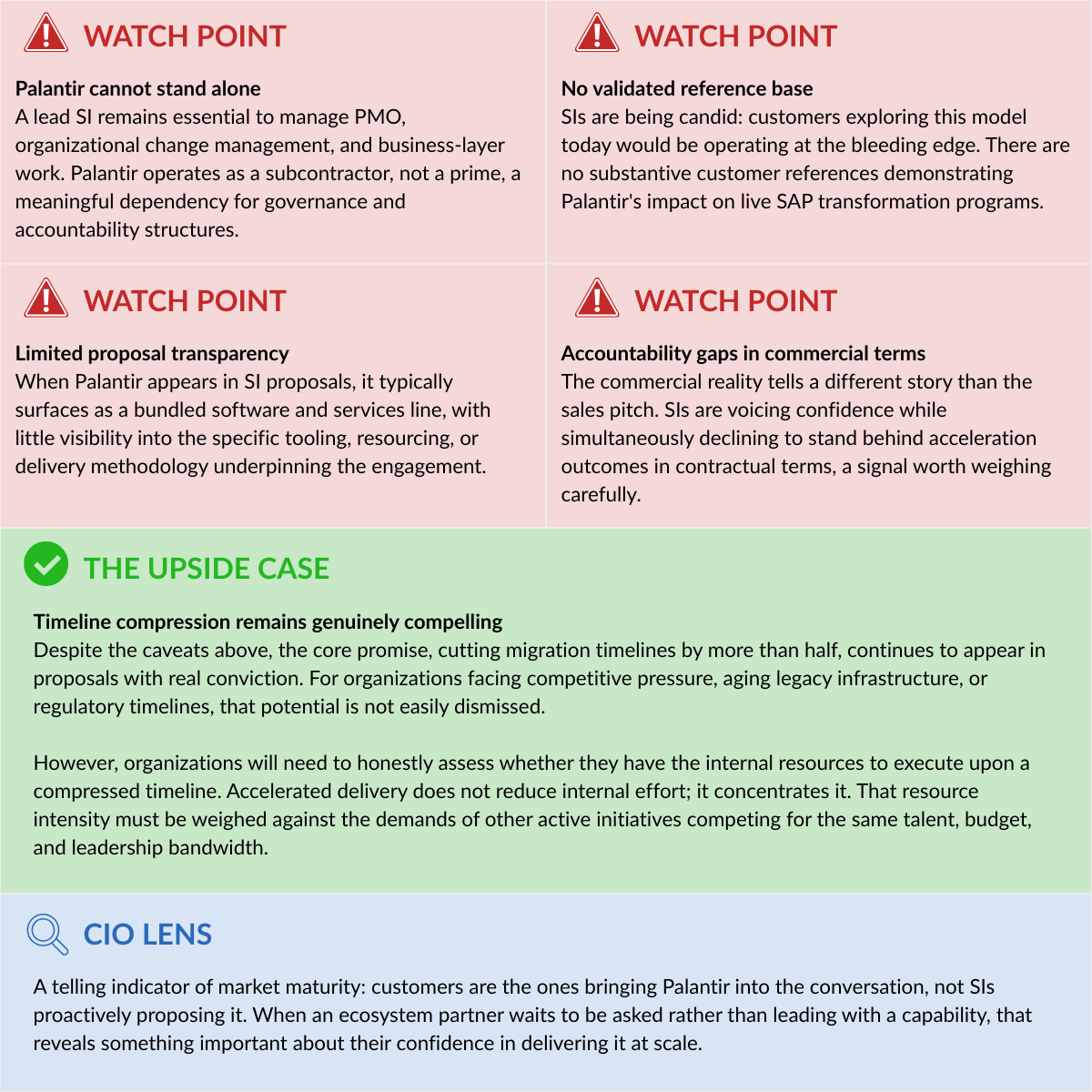
Despite the partnership announcements, the on-the-ground reality reveals a gap between market narrative and market readiness. Organizations that have actively explored Palantir’s inclusion in their transformation programs are encountering a consistent set of themes, and they paint a nuanced picture.
How to Proceed: A Framework for CIOs
The question is not whether Palantir’s AI tools will prove valuable in SAP transformations, because the institutional backing and technology suggest they very well might. The question is whether your organization is positioned to absorb the execution risk of being among the first to find out.
For those who elect to move forward, two imperatives should anchor the engagement:
Demand Full Transparency into Palantir’s Proposal
Do not accept Palantir as a bundled line item. Require a detailed breakdown of the tools being deployed, the resources committed, and the measurable impact expected from each. If your SI cannot articulate what Palantir is doing, when, and with what outcome, that is itself a risk signal.
Hold Both the SI and Palantir Commercially Accountable
SIs are currently voicing confidence while stopping short of contractual commitment to outcomes. Close that gap. Ensure your agreements hold both the SI and Palantir jointly accountable for tool performance, timeline adherence, and project outcomes. If neither party will stand behind the promise commercially, that should weigh directly on your decision to proceed.
Navigating emerging technologies in SAP transformation requires more than market hype. It requires experienced, independent guidance. UpperEdge helps organizations evaluate new delivery models, structure accountability into vendor agreements, and reduce execution risk across complex ERP programs.
See how we help clients drive better outcomes: Explore Our Delivery Approach.