
AI-enabled transformation staffing is a live procurement decision, and the evaluation signal clients rely on, years of experience, is structurally broken for this moment. AI forces clients to rethink how they evaluate SI teams because nobody has twenty years of experience leading AI-enabled enterprise transformations, that experience does not exist yet. The question is no longer how long someone has been doing this. It is whether the SI can demonstrate how their team’s judgment was actually built and tested.
Why Years of Experience Are a Broken Signal
There is a growing concern across the consulting industry that AI is going to create an experience problem. The logic is easy to follow. People become good at complex work by doing it. Junior consultants build the analysis, project managers work through issues, architects wrestle with tradeoffs, and transformation leaders spend years watching good decisions, bad decisions, recoveries, failures, and everything in between.
Over time, those experiences accumulate into something that is much harder to teach from a methodology or a training course: judgment. The concern is that if AI starts doing more of the work that traditionally created those experiences, firms may become more productive in the short term while quietly weakening the pipeline that produces the next generation of experienced professionals.
Most of the industry response so far has been to protect pieces of the old development model. Redesign junior roles. Preserve apprenticeship. Increase coaching and mentoring. Create protected learning time. Make sure people still perform some of the work before AI steps in. Those are all sensible ideas, and they may be necessary. But they are still based on an assumption that I am not sure we should accept: that experience has to develop at roughly the same speed it always has.
Historically, if you wanted someone to become an experienced Program Manager, there was really only one way to do it. Put them on programs and wait. If they were fortunate, over the next ten or fifteen years they would encounter enough difficult situations to develop sound judgment. The problem is that this model is slow, inconsistent, and heavily dependent on chance.
Think about what we really mean when we say someone has twenty years of experience. The twenty years themselves are not valuable. What we value is what we assume happened during those twenty years. We assume the person saw testing fail.
We assume they watched a Systems Integrator insist an unrealistic plan was still achievable. We assume they dealt with bad data, executive pressure, weak governance, scope problems, talent gaps, commercial disputes, and difficult go-live decisions. We assume they were wrong a few times, learned from it, and became better at recognizing what matters. In other words, years of experience have always been a proxy for judgment. They are a useful proxy because, until now, there has not been a practical way to give someone twenty years’ worth of consequential situations without waiting twenty years.
Chess provides an interesting example of why that may no longer be true. A chess player cannot become a Grandmaster because a computer makes the moves for them. At some point, the player has to sit across from another human being and demonstrate that the capability actually resides in them.
Yet computers have transformed how that capability is developed. A player can now encounter thousands of positions, play against opponents of varying strength at any time, immediately analyze mistakes, explore alternatives, and repeatedly practice situations that earlier generations might have waited years to see.
The computer does not eliminate the need for human mastery; it accelerates the process of building it. That distinction is important because it suggests that technology does not have to substitute for judgment. It can also create a much denser environment in which judgment develops.
The flight simulator makes the same point even more clearly. We do not wait for a pilot to experience an actual engine failure before deciding whether they know how to respond to one. We manufacture the experience. We put the pilot into a simulator, create the failure, add bad weather, introduce distractions, and see what happens. The value of the simulator is not that it tells the pilot what to do. The value is that it allows the pilot to experience situations that are too rare, too dangerous, or too expensive to reproduce repeatedly in the real world. The pilot still has to recognize the problem, make a decision, act under pressure, and deal with the consequences. We have accepted for decades that simulation can accelerate the development of judgment in aviation. There is no obvious reason large-scale transformation leadership has to be fundamentally different.
Imagine taking an emerging Program Manager and putting that person into an AI-generated $500 million transformation six months before go-live. Testing is behind. The SI says the plan is recoverable. Data conversion is reporting green, but some of the most important reconciliations have not been completed. Business readiness is slipping. The executive team does not want to move the date because the CFO has already communicated it externally.
Now give the Program Manager access to the same imperfect information they would have on a real program and ask them what they want to do. Let them interrogate the schedule, challenge the SI, talk to simulated workstream leaders, ask for additional data, decide what they believe, and determine what needs to be escalated. Then advance the simulation and show them what their decisions caused. Maybe they caught the problem. Maybe they missed it. Maybe they overreacted. Maybe they solved the immediate issue and created another one three simulated weeks later.
Then run another program with a different company, different SI, different technology, different executives, and different failure mode. What normally takes years may not be the learning itself; what takes years is waiting for reality to generate enough situations from which to learn.
Two Paths Forward: AI as Substitute vs. AI as Accelerant
That is why I think the current debate about AI and experience is too narrow. AI can absolutely create an experience gap if firms use it primarily to remove the work through which people historically developed judgment. If junior roles disappear, if AI produces the analysis, and if professionals become increasingly dependent on the machine to tell them what to do, the concern is legitimate.
Human capability could decline even while output improves. But firms have another choice. They can use AI to remove low-value work while simultaneously using the same technology to create far more high-value developmental experiences than the old model ever produced.
This creates two very different possible futures. Firms that use AI primarily to substitute for human thinking may steadily consume their own base of judgment, while firms that use AI to create more frequent and challenging developmental experiences may actually increase it. Same technology, two completely different outcomes. AI does not determine which line a firm follows. The firm does.
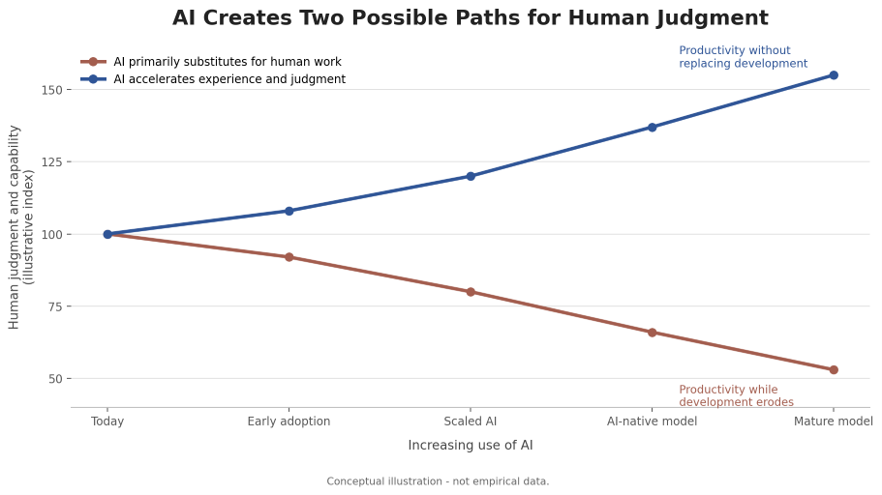
Figure 1. Two possible paths for human judgment as AI adoption increases. Conceptual illustration only.
Which Path Is Your SI Following? Observable Differences
Systems Integrators that systematically convert institutional project history into high-fidelity transformation simulations and validate consultant judgment before deployment will differentiate on team quality. Those that use AI primarily to reduce junior staffing and accelerate billable output will gradually hollow out their capability bench.
Think about the accumulated history inside firms that have delivered thousands of SAP, Oracle, cloud, data, and digital transformations. Those programs contain an enormous amount of latent experience: schedules, RAID logs, testing histories, staffing changes, change requests, cutover decisions, governance failures, recoveries, commercial disputes, and lessons learned. Today much of that knowledge sits in project artifacts, individual memories, and fragmented repositories.
AI creates the possibility of turning that institutional history into something far more powerful: a repeatable environment for developing individual judgment. Instead of allowing a consultant to experience those lessons one project at a time over fifteen years, an SI could expose that person to dozens of highly consequential situations in a fraction of the time and require them to demonstrate that they can handle them.
If that works, it raises a more uncomfortable question about the value we currently place on years of experience. I am not suggesting that twenty-five years of real-world experience suddenly becomes irrelevant. There are elements of accountability, organizational politics, human relationships, and personal consequence that simulations may never reproduce perfectly.
But the scarcity premium attached to tenure could decline significantly if we develop better ways to measure the thing tenure is supposed to represent. Consider one person with twenty years of experience and another with eight years of experience who has also been exposed to fifty highly sophisticated transformation simulations based on real programs and has repeatedly demonstrated exceptional judgment.
Today, most clients would probably choose the twenty-year person because the resume is one of the only objective signals available. But if judgment can be tested directly, the question becomes different. Instead of asking, “How long have you been doing this?” we can start asking, “What can you demonstrably handle?”
That question becomes especially important as clients move into AI-enabled transformations. Every major SI can find people with twenty years of SAP experience, twenty years of Oracle experience, or decades of traditional program management experience. But nobody has twenty years of experience leading the kinds of AI-enabled enterprise transformations companies are beginning to undertake today. The experience simply has not had time to exist.
The Procurement Test: Four Questions to Assess SI Judgment Development
As clients evaluate SI teams for AI-enabled transformations, four questions should guide the assessment:
- How are lessons from other programs transferred into this team?
- How are people being exposed to AI-enabled transformation situations they have not personally encountered?
- How is the SI testing decision-making under pressure?
- Does the SI know that the person being presented as a senior transformation leader possesses the judgment implied by the title, resume, and rate card?
The Real Question Clients Should Be Asking
The concern that AI could weaken the next generation of professional expertise is real, but the outcome is not predetermined. If firms simply automate the work and allow the developmental experiences to disappear, the experience base may decline. If they treat AI as a way to manufacture realistic experience, compress learning cycles, and test judgment before people are placed into roles where clients bear the consequences, the opposite may happen. We may end up developing strong professionals faster than we ever have before.
And if that happens, the most useful question a client can ask an SI may no longer be, “How many years of experience does this person have?” It may be something much more demanding: “Show me their judgment.”
Evaluating SI teams for AI-enabled transformations requires a different assessment framework. UpperEdge helps enterprise buyers define procurement criteria that predict capability, not just tenure. Learn how we assess transformation team readiness.
About the Author