How to Preserve Leverage and Optionality Across an AI Provider Ecosystem
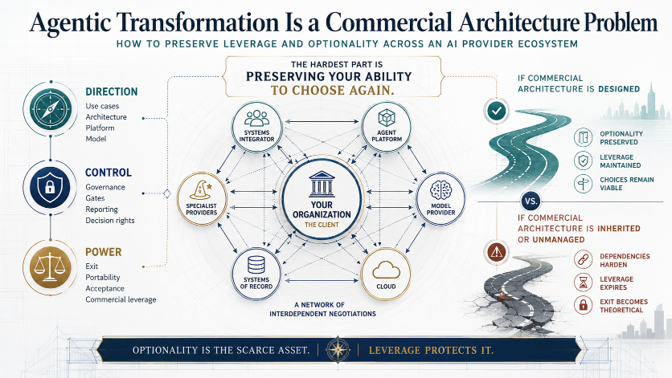
Preserving leverage and optionality across an AI provider ecosystem requires treating your provider negotiations as an interconnected commercial system, not separate transactions. A concession that looks attractive inside one agreement can silently eliminate alternatives in another, before anyone recognizes that a transaction has occurred. That’s why the hardest part of an agentic program is not choosing the technology. It is preserving your ability to choose again.
Most enterprise transformations you have led before this one began with a surprising amount already settled. The core software had been selected. The architecture was familiar. The implementation model had been used before, perhaps many times, and the roles of the major providers were reasonably well understood before anyone started negotiating the implementation agreement.
None of that made an ERP or cloud transformation easy. But commercially, it concentrated the problem. There might be a difficult software negotiation and an equally difficult Systems Integrator negotiation, but most of the provider landscape had already collapsed into a small number of consequential relationships. You knew who you were dealing with, you knew what each party was there to do, and there was a substantial body of market experience against which the decisions could be tested.
Agentic transformation starts in almost the opposite condition. The model may still be in play. So may the agent platform, the cloud, the capabilities already embedded in the systems of record you own, the orchestration layer, the integrator, specialist providers and even the operating model that will ultimately govern all of them.
More importantly, the boundaries between those providers are not yet stable. What one provider does today may become a native capability of another six months from now. A capability you currently expect your SI to build may arrive through a software release. A model decision may become a platform decision, or vice versa. And all of this is happening while organizations feel extraordinary pressure to move.
The technology is developing faster than the precedent, benchmarks and operating experience we would normally rely on to support decisions of this consequence. The window to lead, follow quickly or get left behind feels narrower than anything most organizations have planned against.
That creates something more consequential than additional uncertainty. It creates a different commercial problem. Instead of one or two major negotiations taking place around a largely settled architecture, the client is managing a network of negotiations whose outcomes continuously change one another. A platform decision can narrow the models you can practically use. A cloud commitment can change the economics of those models. The SI you select can influence which architecture appears viable in the first place. And an architectural decision made by someone who would never describe what they are doing as commercial can make a hard-won contractual exit provision almost irrelevant. The problem is not simply that there are more providers. It is that a decision made in one room can quietly change the negotiating position in another.
Once you see the problem that way, it becomes clear why the individual negotiations cannot be optimized independently. A concession can look excellent inside one agreement and still make the transformation worse off overall. You can negotiate very attractive cloud economics while creating an architectural dependency that limits your model choices. You can secure aggressive SI rates while allowing the SI to establish a proprietary delivery structure that makes another integrator impractical later. You can win a contractual right to terminate and then discover that the data, configuration, operational knowledge or orchestration required to exercise that right sits somewhere else in the provider network.
Each individual negotiation can look successful while the client becomes progressively more dependent. A locally successful deal can create a systemically weak commercial position.
Three Decisions that Shape the Commercial System
There is another complication. The decisions creating that position do not all behave the same way.
- Direction – Some decisions establish direction: the business use cases, architecture, platform, model and basic shape of the solution. They are the big bets. They receive executive attention because everyone understands that they matter, and they are expensive to reverse once the program is moving.
- Control – A second group establishes control: the risk frame, reporting standards, gate criteria, decision rights and other mechanisms that allow the program to determine whether what it believed at the beginning is still true. These are the kinds of structural governance decisions explored in UpperEdge’s Crucial Path research. Individually, they rarely look like major financial commitments. Collectively, they determine whether the program can recognize that it is wrong while there is still time to do something about it.
- Power – The third group is different again. These are power decisions: the places where the client’s future commercial position is established or transferred. Who has the right to change the model? What happens if the client wants to introduce another provider? How portable are the data, prompts, configurations and agent workflows? Who determines whether deliverables have been accepted? What warranty actually survives acceptance? What happens when the program needs to draw contingency? What rights exist to terminate, transition or change direction, and can those rights actually be exercised?
These decisions often receive less attention at the point when they are easiest to influence because they do not initially look like architecture. But they determine who has choices later.
Providers behave differently around these three types of decision. They engage direction readily, which is entirely rational. That is where scope and architecture are established and where the provider’s solution has the greatest opportunity to become central to the program. Providers often say relatively little about power because the default position generally works in their favor and silence costs them nothing.
Control is more interesting. Providers will frequently volunteer to help design the governance, reporting, metrics and decision mechanisms that will run the program. Again, there is nothing improper about that; experienced providers have useful methodologies and the client should take advantage of them. But there is a basic governance question worth asking whenever that happens: if the provider is holding the pen on the machinery used to judge the program, who is determining the standard against which the provider itself will later be judged?
Direction, Control and Power also tend to sit in different parts of the client organization. Direction may sit primarily with executive sponsors, the business and technology leadership. Control may reside with the program office and transformation leadership. Power is often distributed across procurement, legal, finance and commercial leadership. All of those groups may be doing their jobs well.
The problem is that the decisions they hold are rarely treated as parts of the same commercial system. Architecture decides one thing. Procurement negotiates another. Legal protects a contractual position. The PMO establishes a governance model. Each decision can be rational on its own while the collective effect is to eliminate an alternative that nobody realized was being spent.
What is Actually Scarce
That is why the scarce asset in an agentic transformation is not simply information. It is optionality: the ability to change providers, models, architectures, operating approaches and commercial positions as the organization learns what actually works.
You are going to learn things during an agentic transformation that you could not reasonably have known when it began. The issue is whether the commercial structure allows that learning to change the direction of the program or merely forces the new information to be absorbed inside commitments that have already hardened.
Leverage is what protects that optionality. And leverage, in this context, means something broader than negotiating a lower price. Meaningful leverage exists when a provider believes the client has another credible way to accomplish the objective. That alternative might be another SI, another model, another platform, a native capability inside an application you already own, or a different way of structuring the work entirely. You may never exercise the alternative. Its commercial value exists because the provider knows that you could.
That makes leverage a perishable asset. It can be spent without anybody recognizing that a transaction has occurred. Imagine a client with three credible SIs competing while the architecture is still open. The client may already have a preferred provider. The other two still have enormous value. Their presence forces the preferred SI to defend its assumptions, expose its architecture, sharpen its economics, strengthen its commitments and think carefully about conditions that might otherwise simply be declared standard.
The moment the client selects one provider and allows the others to disengage, that leverage begins to disappear. Nothing improper has happened. Nobody necessarily made a bad decision. The client simply spent an asset. The question is whether it received enough in return.
This matters because research into large transformation failures suggests that organizations often lose the ability to change direction well before they recognize that they need to. UpperEdge’s Crucial Path research examined approximately eighty large transformation failures and found that realistic alternatives frequently disappeared earlier than visible failure, as architectural, governance, contractual and other commitments narrowed the range of practical responses available to the program.
That is the connection to agentic transformation that matters most. When the environment itself is changing rapidly, the cost of consuming optionality too early rises dramatically.
None of this requires a provider to behave badly. Every participant in the ecosystem has perfectly legitimate incentives to shape the architecture, governance and commercial structure in ways that strengthen its own position. A cloud provider wants more workloads on its cloud. A model provider wants its model embedded. A platform company wants its orchestration layer to become the operating standard. An SI wants the transformation organized in a way that maximizes the value of its capabilities and increases the durability of the relationship. That is what well-run businesses do.
The client has a different responsibility: to understand how those individual incentives interact and make sure the resulting ecosystem still serves the client’s interests.
Commercial Architecture
Commercial architecture is the deliberate design of provider relationships, rights, alternatives and negotiating positions so that a decision made with one provider does not unnecessarily, or unknowingly, surrender leverage or optionality somewhere else. It is the commercial counterpart to technology architecture. Technology architecture determines how the components work together. Commercial architecture determines whether those components and providers can still be changed when they do not.
This cannot be reduced to a standard checklist because organizations do not enter agentic transformation from the same starting point. One company may already have a substantial cloud commitment negotiated years before anyone was thinking about agents. Another may discover that agent capabilities have effectively arrived inside software it already owns through a normal product release. Another may be three months into an SI-led pilot, with the integrator’s accelerator already installed and architectural choices beginning to harden. The starting conditions matter because leverage that exists for one organization may already have been spent by another.
What remains constant are the objectives. Maximize the leverage available to the client and preserve optionality for as long as that optionality has value. From those two objectives follow the practical decisions: which rights need to remain with the client, which alternatives should be kept viable, where competitive tension should be created rather than assumed, which decisions can safely close and which need to remain open, and how a concession in one negotiation changes the client’s position in another. The order matters, but this is not simply a sequencing exercise. The discipline is managing the negotiations as an interconnected commercial system rather than a collection of separate transactions.
And you do not have to be standing at the beginning to do it. Organizations that are still planning, or even those already moving through early execution, usually retain leverage they have not yet spent. There may be phases not yet under contract, future commitments not yet priced, gates not yet crossed, architectural decisions still described as temporary, options sitting inside existing agreements, or providers whose future role has not yet been made inevitable.
The work is to identify those points while they still represent credible alternatives, rather than discovering their value after they have disappeared. The goal is not to predict today which model, platform, provider or architecture will ultimately prove best. In a market moving this quickly, building a commercial strategy around the assumption that you can make every important choice correctly at the beginning is itself a risky strategy.
Make sure the decisions and negotiations you make today do not prevent you from choosing differently tomorrow.
Continue the Conversation
In October, UpperEdge will be hosting a webinar that goes deeper into the mechanics of commercial architecture – how direction, control and power decisions behave in practice, where leverage actually sits across a provider network, how quickly it expires, and what it looks like to deliberately design a commercial architecture rather than inherit one.
And if you are already negotiating, or a few months into execution and uneasy about what may already have been committed, we are happy to spend an hour understanding where you stand and where leverage may still exist.
About the Author