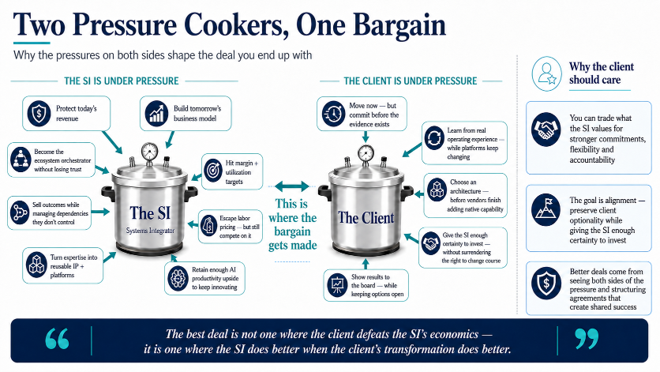
If you know what your SI actually values, you may be able to give it something that is extremely valuable to the provider and relatively inexpensive to you, in exchange for economics, commitments, flexibility or accountability that materially improve the probability of success.
The proposal sitting in front of you is answering two questions at once. The first is yours: how should we deliver this transformation? The second belongs to the SI: how do we win this work while the economics of our own business are changing underneath us?
That second question matters more than most clients realize. The architecture your SI recommends, the accelerator it wants to embed, the pricing model it proposes, the intellectual property positions it takes, the amount of risk it is prepared to accept and the operating role it wants after implementation are all responses to your requirements.
But they are also responses to pressures inside the SI’s own business. Understanding those pressures is not about assuming bad intent or looking for a hidden motive behind every recommendation. It is about understanding your counterparty well enough to negotiate a better deal.
Today’s Business is Funding the Business that May Replace It
Every major systems integrator is trying to protect the economics of the business it has while building the economics of the business it believes it will need. It has to do that while still meeting bookings, revenue, margin and utilization expectations.
AI makes the transition especially difficult because it attacks one of the industry’s most durable economic relationships: for decades, more work generally meant more people and more hours. Agentic AI can reduce both.
At the same time, the SI has to invest in new platforms, proprietary assets, AI talent, governance capabilities and operating models before it knows which of them will create a durable advantage. In effect, the provider is being asked to use today’s profitable business to fund the business that may eventually cannibalize it.
Outcome Pricing Will Not Be a Straight Line
That is why predictions that the industry will simply move from labor pricing to outcome pricing feel too clean. Strategically, most large providers would like to escape the direct relationship between revenue and headcount. Analyst research is increasingly telling them to productize intellectual property, build agentic platforms, sell reusable capabilities, create managed services and price more work around outputs and outcomes.
But competitively, labor remains one of the simplest weapons available. If growth slows, utilization falls or a strategic client is at stake, an SI can still put talented people into the market at an aggressive rate. Those people can also be materially more productive because they are using AI behind the scenes.
The future is, therefore, unlikely to be a straight line from time-and-materials to outcomes. Labor, fixed fee, consumption, subscription, gainshare and outcome models will coexist, and providers will move among them depending on where they can differentiate, where they can capture value and where competitive pressure forces them to compete.
Strategically, the SI may want to escape labor economics. Competitively, it may always need the option to return to them.
Who Keeps the Productivity and For How Long
Clients understandably expect AI to lower the cost of services. If an SI can perform the same work with fewer people, why should the client continue paying economics based on the old delivery model? That is a legitimate question. But there is another side to it. If every dollar of productivity improvement is immediately taken away from the provider, there is little economic reason for that provider to fund the next generation of innovation.
Clients ultimately benefit from healthy SIs that can afford to experiment, build reusable capabilities, train people and take investment risk before a client is willing to pay for the result. The objective should not be to eliminate the SI’s return on innovation. It should be to keep that return connected to genuine differentiation.
That distinction matters because AI advantages may depreciate much faster than the capabilities that created previous generations of consulting advantage. An accelerator that reduces delivery effort by 30 percent today may be replicated by competitors, absorbed into a hyperscaler’s platform or made native to an enterprise software product surprisingly quickly.
Today’s source of margin can become tomorrow’s ordinary market capability. Worse, once a provider has invested heavily in an asset, trained thousands of people around it and built recurring economics on top of it, the provider can become economically motivated to keep that asset relevant even after the market has moved. The efficiencies that create today’s advantage can become tomorrow’s ball and chain if the SI’s economics depend on protecting them rather than replacing them.
That leads to a commercial principle clients should keep in mind: reward innovation without permanently capitalizing yesterday’s innovation. Clients need their SIs to win. They just do not need them to win forever on the same advantage. A provider that creates a demonstrably better way to deliver should be able to earn attractive economics from that innovation. But the commercial model also needs a way to recognize when the market has caught up, when productivity has improved again, or when a different technology can produce the same outcome more efficiently. Otherwise, an outcome-based contract can quietly turn a temporary innovation advantage into a permanent economic rent.
The Client is in a Pressure Cooker of its Own
The client is operating under pressure too, and it is not the same pressure. In an agentic transformation, it needs to learn faster than it commits. Models are changing. Platforms are expanding. Enterprise software vendors are adding native capabilities. Provider roles are overlapping. Some architectural choices that look obvious today may look very different after six months of real operating experience.
Meanwhile, the expectation to show progress now is entirely real, and it pushes in the opposite direction. The client therefore needs to preserve optionality: the ability to change providers, architectures, models, commercial positions and operating approaches as it learns what actually works. Optionality does not mean refusing to commit. It means being deliberate about when, where and how much commitment is given away.
That need for optionality does not automatically create a conflict with the SI, but it creates more friction in today’s environment. What the client experiences as necessary flexibility can look to the SI like uncertainty. The SI needs enough commitment and economic visibility to reserve scarce talent, make client-specific investments, absorb delivery risk and justify putting proprietary capability into the relationship.
The client needs enough flexibility to act on what it learns. The commercial challenge is not to maximize flexibility at any cost. It is to give the SI enough certainty to invest without requiring the client to surrender choices before it has learned enough to make them. That can mean committing firmly to an initial phase while leaving later phases competitive, providing a credible path to managed services without guaranteeing it, or giving the SI upside for hitting defined outcomes without granting an irrevocable claim on future work.
Separate the Underlying Interest from the Opening Position
This is why it is useful to separate the SI’s underlying interest from the contractual position it initially asks for. In one recent negotiation, an SI proposed that a client could use an SI-provided and developed asset only in connection with a single named customer application. The SI’s desire to protect and reuse its intellectual property was understandable. The restriction was not. It would have meant that an asset embedded in the client’s transformation could not be freely used as the client’s architecture evolved, effectively converting the provider’s legitimate IP interest into a client dependency.
The answer did not have to be that the client owned everything. A better bargain could allow the SI to retain ownership and reuse economics while giving the client broad rights to use, operate, transition and support the asset across its environment, including through a successor provider. Understanding the SI’s motivation makes that kind of trade easier to construct. The point is broader than IP: understand what the provider actually needs before deciding whether the mechanism it initially asks for is the right way to provide it.
The same principle applies to orchestration and outcome pricing. SIs increasingly want to orchestrate complex AI ecosystems because orchestration is valuable, durable work. The SI’s alliances are the seam where several provider relationships meet: cloud partnerships, software relationships, trained talent and proprietary accelerators can all influence which architectures look most attractive. That does not make the recommendation wrong. It means the client should understand the commercial context in which it is being made.
Likewise, an SI may genuinely want to assume more accountability for outcomes while still depending on client data, business adoption, third-party platforms, model providers and decisions it does not control. Dependencies, assumptions, relief events and re-baselining can therefore be legitimate mechanisms for making an outcome commitment possible – provided they are not so broad that they make the commitment meaningless.
Different Pressures Create Different Negotiating Currencies
Different providers will respond to these pressures differently. A global SI with enormous legacy revenue, a large workforce and billions available for investment is solving a different business problem from a mid-tier provider caught between scale and agility. An AI-native entrant with little legacy revenue to protect is solving a different problem again.
One may value a multi-year operating role. Another may care far more about referenceability or entry into an account. One may protect a proprietary platform aggressively. Another may be willing to build on the client’s chosen stack because it has no installed asset to defend. One may resist labor pricing because it is trying to establish new economics. Another may use labor pricing precisely because it needs to win the work. Those differences are negotiating information.
This is where understanding the pressure cooker becomes useful rather than merely interesting. Sophisticated negotiation is not about forcing every term toward the client. It is about identifying things the other side values disproportionately and trading them for things you value more.
A path to recurring work may be worth more to the SI than it costs the client to offer, provided it is earned rather than guaranteed. Reuse rights in generic IP may be extremely valuable to the SI while exclusivity over that IP may be of little value to the client. The SI may value retaining some productivity upside more than the client values immediate pass-through, while the client may value periodic market resets, portability and successor rights far more.
The more clearly those interests are understood, the more room there is to build a commercial arrangement that is not simply a compromise between opposing positions but a better design for both parties.
Supplier incentives are information, not only risk. A provider can absolutely use proprietary assets, restrictive rights, opaque pricing or excessive dependencies to create leverage at a client’s expense, and clients should be prepared to recognize and challenge that. But stopping there misses the larger opportunity.
A provider that earns more when productivity improves has a reason to keep improving productivity. A provider that earns future work only after proving outcomes has a reason to make the first phase successful. A provider that can reuse its IP without restricting the client’s operating freedom has a reason to keep investing in that IP without making the client captive to it.
What This Means for the Proposal in Front of You
The next few years are likely to be uncomfortable for the systems integration industry. Providers have to cannibalize pieces of their historical model, create new sources of differentiation before the old ones disappear, decide how much AI productivity to share, determine which assets deserve to remain proprietary, change pricing models without losing competitive flexibility, and become trusted orchestrators while remaining economically interested participants in the ecosystem. They have to do all of that while continuing to perform for clients and satisfy the economics of the current business.
Clients do not need to solve those problems for their SIs. But they should understand them. The proposal sitting in front of you is not merely a statement of how the SI intends to deliver your transformation. It is also evidence of how that provider is trying to navigate its own transformation.
Understanding that context can help you distinguish a legitimate provider need from an unnecessarily restrictive position, recognize where the SI has flexibility it may not initially advertise, and identify trades that improve the economics and accountability of the relationship without sacrificing the client’s ability to keep learning and changing course.
The best commercial relationship is not one in which the client defeats the SI’s economics. It is one in which the SI does better economically when the client’s transformation does better operationally – without requiring the client to give up the optionality it needs to choose differently when the market, the technology or the evidence changes.
UpperEdge helps enterprise buyers decode SI positioning, benchmark costs and staffing assumptions, and build commercial arrangements that align provider incentives with transformation outcomes. From proposal evaluation to contract negotiation to mid-program accountability, we bring the market intelligence and structural expertise that turns understanding into leverage. Explore UpperEdge’s IT Services Advisory Practice.
Selected research and industry references
- BCG (2026), The $200 Billion Agentic AI Opportunity for Tech Service Providers
- IDC (2026), From Labor Arbitrage to Platform-Led Outcomes: How Agentic AI Is Rewriting the IT Services Playbook
- California Management Review (2026), From Rate Cards to Outcomes: Consulting’s Fourth Transformation
- Mayer Brown (2026), Key Contract Issues in Agentic AI Implementation and Integration Deals
- Omdia(2025), How partners win in the Agentic AI era: Pricing, packaging, and strategy for AI
- HFS Research (2026), HFS Horizons: Agentic Services, 2026
- Cognizant (2026), The new value model for enterprise services
About the Author