
The systems integrator market is growing in 2026, but the composition is shifting. AI is the primary demand catalyst, pulling enterprises back to ERP modernization. At the same time, fixed-price contracts now represent roughly 60% of Accenture’s work, and the gap between AI booking volume and demonstrable delivery productivity remains wide. 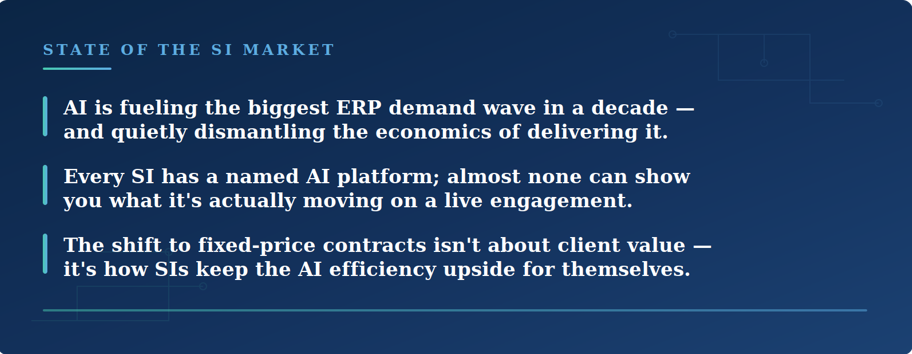
The Big Players: Consulting Numbers Tell a More Complicated Story
Accenture
Accenture’s consulting segment generated $9.3 billion in Q3 FY2026, up 4% in U.S. dollars (1% in local currency), against total company revenue of $18.7 billion. New consulting bookings for the quarter came in at $10.3 billion, a book-to-bill of 1.1. The more telling shift, though, is AI:
- Accenture no longer reports advanced AI as a standalone line at all – the last time it broke the figure out, in Q1 FY2026, it booked $2.2 billion of advanced AI work in a single quarter, nearly double the prior year.
- That decision is itself the signal: Accenture folded AI into its headline results because AI work is now simply how consulting gets done, not a category worth isolating.
IBM
IBM’s consulting segment tells a more cautious story. When it reported Q2 2026, the company trimmed its full-year revenue growth guidance to 4–5%. A few things worth noting:
- Consulting revenue was essentially flat at $5.33 billion (up 1% at constant currency), but profitability improved: segment profit rose approximately 15% to $647 million, and margin expanded to 12.1%. IBM is generating more profit on largely unchanged revenue.
- Signings increased 6% to roughly $5.0 billion, marking a second consecutive quarter of growth. Both consulting units grew only 1%, however, and IBM is counting on those signings to translate into stronger revenue growth later in the year.
- AI is now driving a substantial share of new work. Generative AI accounts for approximately half of consulting signings and more than 30% of the backlog, a marked increase from prior quarters.
- IBM also established a dedicated Google Cloud practice within its consulting arm, combining its Consulting Advantage tooling with Google’s Gemini. This suggests a strategy of building AI capability through partnerships rather than relying solely on its own watsonx platform.
Deloitte, EY and PwC
The SIs that do not have to report earnings publicly are moving just as fast:
- Deloitte rolled out SAP Joule for Consultants late last year, an AI assistant baked into the SAP project workflow to help consultants find faster answers and cut down on rework
- Deloitte also teamed up with UiPath to launch Agentic ERP, which targets companies running their operations on messy spreadsheets and disconnected systems that need more automation
- EY introduced an AI-native approach to how they build and deliver software on transformational programs, called EY.ai PDLC – instead of layering AI onto a traditional software delivery process, the whole development lifecycle is designed around AI from the start
- PwC ran their own SAP Cloud implementation internally recently, which was particularly notable since most SIs selling ERP transformations have never been through one themselves as the client
AI: Simultaneously the Biggest Tailwind and the Most Disruptive Force for the SIs
The dual nature of AI’s impact on the SI consulting model deserves a clear-eyed look, free of the analyst hype that tends to dominate this conversation.
AI as a Demand Driver
On one hand, AI is the single biggest demand catalyst the industry has seen in a decade. It is pulling enterprises back to the transformation table, prompting them to modernize data foundations, re-architect business processes, and revisit ERP landscapes they thought they’d dealt with years ago.
IBM’s CEO Arvind Krishna captured this dynamic directly: AI bookings are “overcoming the headwinds from staff augmentation projects going away and people getting rid of discretionary spending.” In other words, AI demand is filling the gap left by traditional consulting work that clients are either automating or deferring.
Analyst Projections vs. Reality
On the other hand, analyst projections of 40–50% effort reduction on ERP programs make for compelling research headlines, but they don’t reflect what’s actually happening on the ground. In practice, across active ERP transformation engagements, productivity gains from AI tooling are running at less than half of analyst projections. Real, meaningful, and worth pursuing, but not the program-halving step change the market narrative would have you believe.
That gap between projection and reality matters, because SIs are making significant go-to-market bets on AI productivity claims that clients are increasingly savvy enough to pressure-test. Every major firm now has a named AI delivery platform. What’s harder to find is transparent, engagement-level data on what those platforms are actually moving.
The honest characterization is incremental improvement layered onto existing delivery models, not a reinvention of how ERP programs get run. That’s the right and responsible place to be given where the tooling actually is, but it should be described as such, not dressed up as transformation.
Fixed Fee Model Shift
One data point that cuts through the marketing: Accenture noted that approximately 60% of its work is now fixed price, up roughly 10 percentage points over the last three years. That shift isn’t being driven by clients, it’s being driven by the SIs themselves.
As AI compresses delivery effort, firms like Accenture can commit to a fixed price with more confidence, protect their margins as headcount requirements shrink, and avoid a T&M model where clients can directly see, and start questioning, why they’re paying for fewer hours on the same scope. Fixed price is how SIs capture the efficiency upside of AI rather than passing it back to the client. That negotiation is now a live conversation on most large ERP programs.
What This Means for your ERP System Implementation
AI bookings growth doesn’t equal AI delivery maturity. IBM’s generative AI work now makes up about half of its consulting signings, and Accenture’s advanced AI work grew pervasive enough that it folded the figure into its headline numbers. These are real commercial signals, but backlog conversion takes time, and the gap between what SIs are booking on AI and what they’re demonstrably delivering in production is still wide. Ask your SI to show you specifically:
- Where AI tooling is deployed in their ERP delivery methodology
- What productivity data they have from live engagements, not pilots
The data readiness problem is the hidden constraint. Accenture’s CEO called client data preparedness “nascent” on recent earnings calls, and it shows up in programs constantly. Companies rushing toward agentic AI use cases without first modernizing their ERP data foundations are setting themselves up for extended timelines and scope creep.
Palantir is increasingly positioning itself in this space through its Foundry platform, which layers an AI-enabled ontology over existing ERP investments rather than replacing them. Its partnership with Accenture and Deloitte frames this explicitly as a way for organizations to “reimagine work and infuse AI while rationalizing existing technology”, without waiting for a full ERP go-live. It’s a legitimately different value proposition, and one that more ERP program sponsors are asking about. Data remediation is becoming the longest pole in the tent on ERP transformations, and it rarely gets the program budget it deserves at the outset.
The Bottom Line
The SI consulting market in 2026 is growing, but the composition of that growth is shifting in ways that matter:
- AI bookings are accelerating
- Fixed-price contracts are becoming the norm
- Firms incurring hundreds of millions in restructuring charges to reshape their delivery workforces are sending a clear signal about where they think the model is headed
For ERP buyers, the complexity of transformation is not going away. But the conversation about how it gets delivered, who should bear the efficiency upside from AI tooling, and whether your SI’s AI story holds up under scrutiny? That conversation is now overdue.
Your SI’s AI story probably sounds compelling. The data readiness problem that derails most programs? Less so. Enterprises that validate their data foundations before signing fixed-price agreements avoid the extended timelines and scope creep that most vendors gloss over. UpperEdge advisory on SI selection and ERP delivery strategy ensures your transformation roadmap is built on your actual constraints, not vendor projections. Get transformation support today.
About the Author