AI is making vendor proposals clearer, more persuasive and easier for both humans and machines to read. Clients need to raise the standard of how those proposals are evaluated.
Enterprises evaluating AI-enhanced vendor proposals need to separate document quality from deal quality. Vendors are using generative AI to optimize proposals for both human evaluators and AI-assisted review tools. A more polished, consistent, persuasive proposal does not mean better economics, stronger protections, or a more capable delivery model underneath it.
Don’t Let Better Proposals Hide Worse Deals
This matters because the vendors submitting those proposals are using AI systematically. Proposal teams now use generative AI to check compliance with RFP requirements, improve clarity, eliminate inconsistencies, strengthen win themes and tailor responses to what the buyer has said matters most. A 2026 Loopio survey found that 79% of proposal teams had used generative AI in their RFP response process. The result: the proposals you’re receiving are going to get noticeably better. That’s the opening problem you need to recognize and plan for.
There is another change occurring at the same time. Vendors are using AI to write proposals while clients are increasingly using AI to read them. Procurement organizations are adopting generative AI to analyze RFPs and contracts, support sourcing activities and help manage supplier decisions.
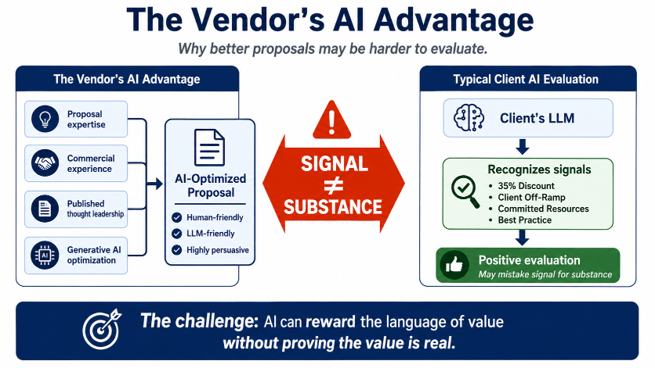
That means sophisticated vendors can increasingly assume their proposals have two audiences. One is the human evaluation team. The other is the LLM helping that team interpret what the vendor submitted. Vendors have spent decades learning how human proposal evaluators respond to language, structure, commitments and commercial framing. They now have every incentive to learn how machine evaluators respond as well.
How Vendors Are Optimizing AI Proposals for Dual Evaluation
UpperEdge has already warned clients about this first-order risk, arguing that AI-assisted proposal generation would become normal and that clients would need stronger validation, accountability and AI literacy. The issue has now moved a step further. The question is no longer simply whether AI helped write the response. It is whether the proposal has been tuned to perform well with an evaluator that may itself be using AI.
We already have evidence that this behavior emerges when AI enters a competitive selection process. Researchers recently examined approximately 200,000 real-world resumes and found hidden attempts to influence LLM screening in roughly 1% of them, with usage increasing over the prior one to two years. More interestingly, more than 90% of the detected attempts were not crude instructions telling the model to rank the applicant first.
A separate study published in the Findings of ACL 2026 tested something subtler: self-promotional language that added no additional qualifications but was designed to influence an LLM evaluator. It improved rankings under certain conditions and could even result in a weaker candidate being ranked above a stronger one.
The Evidence: How LLMs Score Vendor Proposals
The analogy to an SI selection is hard to miss. Replace the applicant with the Systems Integrator, the resume with a 400-page proposal, the hiring criteria with the RFP scoring criteria and the resume-screening model with the client’s AI evaluator. This does not mean major SIs are secretly inserting malicious prompts into proposals. There is no evidence to support that claim, and the issue is much broader than prompt injection.
The research establishes something more important: once a machine participates in a competitive selection decision, competitors begin optimizing the document for the machine. Major SIs already know how proposals are scored and already have sophisticated processes for tuning responses toward those criteria. Generative AI makes that tuning faster, cheaper and considerably more powerful.
AI Proposal Evaluation Can Mislead Without Human Judgment
Recent supplier-evaluation research gives us direct evidence in procurement, not just hiring. A 2026 Journal of Business Logistics study compared three reasoning models with human procurement professionals across 123 actual supplier bids from 31 State of Ohio IT projects. The models showed strong consistency and human alignment on compliance signals such as technical specifications, but substantially more scoring volatility on competitive signals such as value-add propositions.
The researchers concluded that generative AI can be well suited to qualification screening while human judgment remains critical for assessing differentiation. That distinction maps directly to the problem clients face with polished SI proposals: AI may be very good at confirming that the right signals are present without being equally reliable at judging how much those signals are actually worth.
The influence may begin even earlier than the proposal itself. Researchers have now developed an entire field called Generative Engine Optimization, or GEO, examining how published material can be structured to increase its visibility in generative search results. The foundational GEO research demonstrated that changes involving citations, quotations, statistics and content structure could materially increase how prominently information appeared in generative answers.
That matters because major technology vendors and SIs publish enormous volumes of legitimate thought leadership explaining their methodologies, maturity models and definitions of best practice. As clients increasingly ask AI questions such as “What does a best-practice ERP transformation look like?” or “What governance model should I require from an SI?”, those systems may retrieve and synthesize material created by the same organizations that will ultimately compete for the work.
That does not mean vendors control what an LLM believes, nor does it prove that publishing thought leadership changes the underlying training of a foundation model. The immediate issue is simpler. Vendor-created material becomes part of the information environment from which AI constructs its answers. A vendor can therefore help shape the vocabulary the market associates with “best practice”, and then submit a proposal that aligns extremely well with that vocabulary. The seller does not need to manipulate the AI directly. The seller simply needs to be very good at influencing the information the AI encounters.
There is another body of research that should concern anyone who negotiates large technology agreements. A peer-reviewed EMNLP 2025 study examined cognitive biases in LLM-driven product recommendations, including the effect of discount framing. In one experiment, the researchers compared actually cutting a product’s price in half with leaving the higher price in place and presenting it as discounted. The discount framing caused more products to be recommended even though the supposed discounts averaged roughly 26%, while the alternative was a genuine 50% price reduction.
Anyone who negotiates enterprise software or SI services should recognize the problem immediately. A vendor presents a proposal with a “standard value” of $100 million and a “strategic client investment” of $72 million. The slide proudly announces that the client is receiving a 28% discount. An experienced commercial advisor does not conclude that $72 million is a good deal because someone put “28% discount” next to it.
The first question is: discount from what? Was $100 million ever a credible market price? How do the underlying rates compare with comparable transactions? Is the staffing model efficient? How much contingency is embedded in the estimate? Did the vendor establish the baseline against which it is now claiming savings? The research matters because it shows that an LLM can respond strongly to the signal of value even when a more substantive indicator of value is available.
What AI Misses in SI Contracts and Pricing
I recently encountered the same problem in a different form while reviewing an implementation SOW. The client had specifically requested contractual “off-ramps” because it wanted the ability to exit the engagement at defined points if the program was not working. When I asked an LLM to perform a general review of the agreement, it highlighted the off-ramps as a significant advantage for the client and characterized them as providing meaningful flexibility. On the surface, that conclusion made sense. Off-ramps sound client-friendly.
The problem appeared when we examined how the provisions actually worked. The conditions surrounding the off-ramps made them extremely difficult to exercise in practice. More importantly, the provisions needed to be evaluated against the broader termination rights a client would ordinarily expect in a major engagement, including termination-for-convenience rights that had effectively been constrained by the structure.
The AI recognized the language of client protection and inferred that meaningful client protection existed. It did not adequately test whether the client could actually use the right or whether the client was better off than it would have been under a more conventional structure.
That distinction extends well beyond off-ramps. A proposal can describe “committed resources”, while the contract gives the vendor broad substitution rights. It can offer a “fixed price”, while assumptions, dependencies and change provisions transfer most of the delivery uncertainty back to the client.
It can promise “risk sharing”, while the actual remedies leave the client bearing almost all of the economic consequence when performance fails. It can advertise a substantial discount against a baseline that has little relationship to market value. The terminology may be accurate. The conclusion implied by the terminology may not be.
That is why clients should assume major proposals will increasingly be optimized for both human and machine consumption. Vendors have strong incentives to make their proposals clearer, more persuasive and easier for AI systems to interpret positively. They also have deep experience in proposal strategy, pricing, contracting and delivery, and many of the largest SIs have been at the forefront of enterprise generative-AI adoption. The client may be using AI to evaluate its fifth major proposal. The vendor may be combining AI with institutional knowledge developed across hundreds or thousands of pursuits.
How to Evaluate AI-Enhanced Proposals: A Checklist for Procurement Teams
The answer is not to stop using AI. Clients should use it more aggressively. An LLM can read hundreds of pages of proposal material, compare responses against requirements, identify inconsistencies, trace commitments and expose qualifications at a scale that would otherwise require enormous human effort. But clients need to understand that AI alone does not level the playing field when the other side is combining AI with decades of specialized commercial experience.
The client needs the same combination. An experienced independent advisor should not replace the client’s AI. The advisor should make the AI smarter about what it is looking for. When the proposal says “35% discount”, the evaluation should ask what baseline created the discount and how the resulting economics compare with the market.
When it says “client off-ramp”, the analysis should determine exactly when the right can be exercised, what costs survive and what alternative rights the client surrendered. When the vendor promises “committed key personnel”, the evaluation should determine what prevents substitution and what remedies exist if those people disappear. When a proposal calls something “best practice”, someone needs to ask who defined the practice and whose economic interests it serves.
The next proposal you receive may be the best proposal your vendor has ever produced. The question is whether the deal underneath it is. Evaluate AI-enhanced proposals by using AI to audit compliance and consistency, then applying experienced commercial judgment to verify that the actual commitments, economics, staffing and protections match what the language promises.
Proposal quality will continue to improve. Clients should expect that. A poorly written response, an obvious inconsistency or an inadequately addressed requirement will become easier for vendors to identify and correct before submission. That means the polish of the proposal itself will become a less reliable indicator of the quality of what is being offered.
Clients, therefore, need to raise the standard of evaluation. The question is no longer simply whether the vendor submitted a compelling proposal. Increasingly, it will. The harder question is whether the commitments, economics, staffing, protections and delivery model underneath that proposal are as good as the language describing them.
That is the real opportunity. Use AI but make sure the AI is asking the questions that experience has taught us to ask. The next proposal you receive may be the best proposal your vendor has ever produced. The question is whether the deal underneath it is.
UpperEdge’s Project Execution Advisory Services help you evaluate SI proposals by combining AI audit with commercial expertise that questions assumptions, tests mechanics, and validates that economics match promises.
About the Author