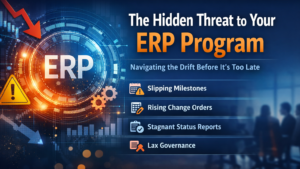
Enterprise technology programs rarely fail in dramatic, obvious ways. They drift quietly, gradually, and often invisibly to the people who have the most at stake. Milestones slip without clear root causes. Status reports stay green longer than they should. Governance meetings fill calendars but produce no decisions. By the time leadership recognizes something is structurally wrong, the program has already lost time, budget, and credibility.
Industry analysis shows that a significant share of enterprise technology implementations fail to meet their original objectives. The reasons are rarely technical. They are organizational, commercial, and governance-related, exactly the conditions that allow drift to take hold undetected.
Across programs I support today, the same patterns surface with remarkable consistency. They are worth naming directly, because naming them is the first step to intervening before the cost becomes irreversible.
Are you seeing any of these in your program?
Why Governance Infrastructure Is Not the Same as Governance Discipline
Many struggling programs have all the right structural elements in place: a RAID log, steering committee, weekly status reports, and color-coded decks distributed on time. From the executive floor, everything appears to be functioning.
But structure and discipline are not the same thing. RAID logs exist with entries that have no owners and no due dates, or due dates that passed weeks ago with no escalation. Status reports carry stale content unchanged from the prior week. RAG (or BRAG) ratings hold steady even when milestones have clearly slipped. Decisions get taken offline and are never captured in a system of record.
If your reporting is producing Work Performance Data but not Work Performance Information, what are you really telling your steering committee? You are telling them the program is being managed. Not that it is under control. That distinction matters enormously when the first significant problem surfaces and leadership ask how long it has been building.
Why Status Is Not Decision-Grade
The reporting is built to communicate activity, not to surface risk or drive decisions. Decision-grade reporting requires a single integrated Critical Path Method (CPM) view with clear ownership, Phase Gate criteria that function as enforceable entry and exit standards, and burn-down views that show Schedule Performance against baseline rather than narrative descriptions. Without these, leaders are operating on the appearance of control rather than the substance of it.
When dependencies are scattered across workstream slides rather than governed as a single chain, risk accumulates invisibly. When “dev complete” is reported before acceptance criteria have been verified, the schedule looks better than it is. The net effect is late-cycle churn, with compressed UAT windows, deferred defect resolution, and a go-live decision made under pressure rather than evidence.
Industry research consistently shows that enterprise technology programs frequently run longer than planned and exceed their budgets, with scope expansion and underestimated staffing among the most common drivers. These are not unexpected disruptions; they are direct consequences of the governance gaps described above. If you are lucky, that is.
More often, leadership is still trying to understand how things got this bad when the vendor arrives with a significant change order, confident that the ambiguity in the program’s own artifacts gives them cover.
Cost overruns in enterprise technology implementations rarely appear as a single event. They build gradually, one deferred decision, one uncontrolled change order, and one missed gate at a time, until the cumulative impact becomes unavoidable.
If your status reports look the same week over week, ask what has actually changed and why no one is saying so.
What Intervention Actually Requires
What separates programs that recover from those that do not is rarely the quality of the replanning exercise. It is whether the organization is willing to name what is happening before the cost of correction becomes unbearable.
The evidence is almost always already there. The cumulative effect is what we term as “Value Erosion”. Here are a few common symptoms:
- Past-due RAID items
- Schedule Variances without documented Corrective Actions
- Change orders processed outside of Integrated Change Control
- Status report content that has not changed in two consecutive weeks
Intervention means reading those artifacts with the right lens, elevating what they reveal, and making governance discipline a leadership expectation rather than a project management courtesy.
The evidence of drift is visible earlier than most leaders realize. The question is whether anyone is willing to act on it before the cost becomes irreversible.
If your program is showing signs of drift, slipping milestones, rising change orders, or governance that generates activity but not decisions, UpperEdge’s Project Execution Advisory Services can help you see what the status reports are not telling you, restore accountability across your vendor ecosystem, and reclaim control before delays and cost overruns become unavoidable. Learn how.