Agentic transformations are an unavoidable project in today’s market. Here’s how to ensure your agentic control stack is built to last as models improve.
What Happens to Your Agent Control Stack as Models Improve?
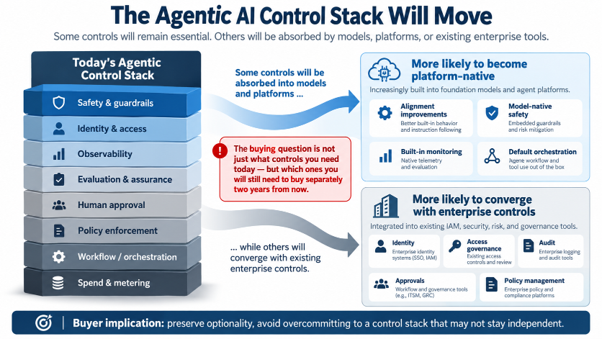
The agent control stack you’re assembling today is being shaped by model immaturity, not durable enterprise requirements. As foundation models improve, platforms consolidate, and existing governance tools extend to agents, a significant portion of today’s specialized control products will migrate, bundle, or become redundant, taking your operating model with them if you’ve hardened it prematurely.
That is not to say buyers should take fewer precautions today. But they should be very careful about turning the limitations of today’s models into permanent enterprise architecture.
A portion of today’s control environment exists because foundation models are still imperfect. They hallucinate. They can misinterpret instructions. They can be manipulated. They do not always recognize when they are uncertain. Tool use can still be unpredictable, and complex multi-step reasoning can break down. So we compensate. We add output validation, secondary models, evaluation platforms, constrained tool access, additional monitoring and human checkpoints. We surround the agent with software designed to detect or prevent behavior we do not yet fully trust.
Today, many of those controls may be entirely appropriate. But buyers should pay attention to the direction of travel. Foundation models are improving rapidly in instruction following, grounding, structured outputs, reasoning, self-evaluation, tool use and their ability to recognize uncertainty. As those capabilities improve, it is reasonable to expect that some of the controls we are adding around today’s models will become lighter, some will be absorbed into the model or platform itself, and some may simply stop being worth paying for.
That distinction matters because we should not assume that a compensating control required by a 2026 model automatically deserves a permanent place in the enterprise architecture.
There is a second force at work as well. Even where the control itself remains necessary, that does not mean the standalone software product providing it will remain necessary. The foundation-model providers, hyperscalers and enterprise platforms all have strong incentives to absorb more control functionality into their own environments. Evaluation, guardrails, identity, tool permissions, memory management, observability, agent lifecycle management and policy enforcement all make their platforms safer and easier to consume. They also make those platforms more complete.
So some of the point products being introduced today may not disappear because the need disappears. They may disappear because the capability gets bundled somewhere else.
Then there is a third dynamic that may be even more important. A surprising number of the controls we need for agents are not actually new.
Enterprises have spent decades answering questions such as: Who are you? What are you allowed to access? What transactions can you execute? What requires approval? What information can you see? What did you do? Who authorized it? Can I prove what happened six months from now?
Those questions do not fundamentally change because the actor is an AI agent rather than a person, a service account, an application or an RPA bot.
That makes me skeptical that most enterprises will ultimately want a completely separate governance stack for agents. It seems much more likely that the existing enterprise control environment will expand to accommodate a new class of actor. Identity platforms will govern human and agent identities. Workflow systems will route human and agent approvals. Observability platforms will ingest human, application and agent activity. GRC tools will capture evidence regardless of whether the action was performed by a person or software. Existing transaction controls, approval hierarchies and separation-of-duty rules can increasingly be applied to agents as well.
We are already beginning to see that direction in the market. Identity and security providers are increasingly treating agents as another governed identity type rather than assuming an entirely separate infrastructure must be created for them. The same logic is likely to spread into workflow, audit, data protection, IT service management and other enterprise control domains.
Put those three forces together and the buying question becomes more interesting.
First, the models themselves get better, reducing the need for some compensating controls. Second, the AI platforms absorb functionality that is today provided by specialists. Third, the enterprise platforms companies already own extend their existing controls to agents.
That creates substantial pressure on the control architecture being assembled today.
And yet companies are being asked right now to select products, integrate them, build operating procedures around them, train people to use them and potentially make multi-year commitments. That should make buyers cautious. Not because the controls are unnecessary, but because we do not yet know which controls are durable and which implementations of those controls are durable.
Those are two very different questions.
Which Agent Controls Are Durable, and Which Are Temporary?
There is also a counterintuitive side to this. Better models will not necessarily mean less governance. In some areas, they may mean more governance – just a different kind of governance.
Consider an agent that can only recommend a purchase order today. Because we do not fully trust the model, we might surround the recommendation with validation, evaluation and human review. Now imagine the same agent several years from now, when the model has become reliable enough that the business is willing to let it issue the purchase order itself.
At that point, we may need less checking of the answer. But suddenly identity, authority, transaction limits, segregation of duties, audit and accountability become much more important. The governance requirement did not go away. It moved.
That distinction may ultimately prove to be one of the more important ones in agentic AI. Some controls exist because the intelligence is immature. Others exist because the enterprise is delegating authority. The first category is vulnerable to technological improvement. The second is not.
That is why I expect some of the most durable controls around agents to look remarkably familiar. Identity, authorization, financial limits, approvals, separation of duties, auditability and accountability are not controls we invented because AI is imperfect. They exist because enterprises need to control who – or what – is allowed to act on their behalf.
How Should Buyers Build in Review Points for Agent Controls?
The practical implication for buyers is straightforward: build the controls necessary to operate safely today, but do not harden today’s answer into tomorrow’s architecture unless you have to.
That means being cautious about long commitments to specialized control products whose functionality could migrate into the foundation model, hyperscaler or platforms you already own. It means understanding where the control logic actually resides, who owns the policies and configuration, what data is portable, and what must be rebuilt if you change products later.
It also means creating planned points to reconsider the control stack as the technology improves. A control that is necessary during a pilot may not deserve to survive into scale. A point product that fills an important gap today may become redundant once the hyperscaler or enterprise platform introduces the same capability. Buyers should expect that and create explicit review points where controls can be retired, consolidated or replaced rather than allowing each new requirement to become permanent simply because it was once necessary.
That is an important part of learning in an agentic program. The objective should not be to determine the perfect control architecture at the beginning. It should be to learn which controls are actually required, which add measurable value, and which become unnecessary as the underlying technology changes. The architecture should be capable of changing as the evidence changes.
There is a commercial implication as well. Specialized agent-governance vendors, foundation-model providers, hyperscalers and the enterprise platforms a company already owns are increasingly competing to provide overlapping control capabilities. That overlap can look like complexity, but to the buyer it is also leverage.
If three different parts of the supply base can provide evaluation, policy enforcement, observability or lifecycle management, the buyer should be cautious about prematurely assigning that capability to one provider for the long term. The better approach may be to preserve competition while the market develops, use early deployments to determine which capabilities actually differentiate, and make providers earn the right to become the durable control layer.
This is especially important because the commercial incentives are not neutral. Every provider would prefer that its control plane become the place where the enterprise governs agents. Once that happens, adjacent decisions about models, infrastructure, orchestration, tooling and managed services can become easier for that provider to capture as well. The control stack is therefore not just a risk architecture. It can become a source of commercial gravity.
That makes leverage something buyers should exercise while the market is still unsettled, not after the architecture has hardened.
It also means paying particular attention to the operating model.
The deepest lock-in may not be the software license itself. If a systems integrator builds your approval processes, testing framework, agent registry, evaluation procedures, exception management, monitoring processes and change controls around a particular collection of tools, you can technically preserve the right to replace those tools and still discover that replacing them is extraordinarily difficult.
That is operating-model lock-in.
The technology may remain portable while the way you run the environment does not.
We talk a lot about preserving optionality around foundation models, hyperscalers and agent platforms. I think buyers should add control-stack optionality to that list.
You need enough control to operate safely now, but you also want the ability to retire, consolidate, replace or absorb those controls as the market matures. That means avoiding unnecessary dependencies, separating policy from product where practical, understanding integration points, keeping control evidence portable, creating explicit learning points, and maintaining competition wherever multiple providers can credibly supply the same capability.
There is a reasonable chance that three years from now the control environment looks materially different from the one being sold today. Some controls may disappear because the models got better. Some may become native capabilities of the AI platforms. Some may migrate into the enterprise tools already being used to govern people, applications and transactions. And some may become more important because the agents themselves are doing more.
The buyer’s job is not to predict exactly which of those outcomes will occur.
It is to avoid making a prediction you do not have to make.
Build the control stack you need today without locking in the one you will not need in three years.
UpperEdge advisors review agentic AI contracts and operating models for the commitments that are hardest to unwind: term length, portability of policies and configurations, ownership of control logic, and exit terms. Talk to an advisor before your next multi-year commitment.
About the Author